

Young adults still face rising gastric cancer disparities amid overall decline
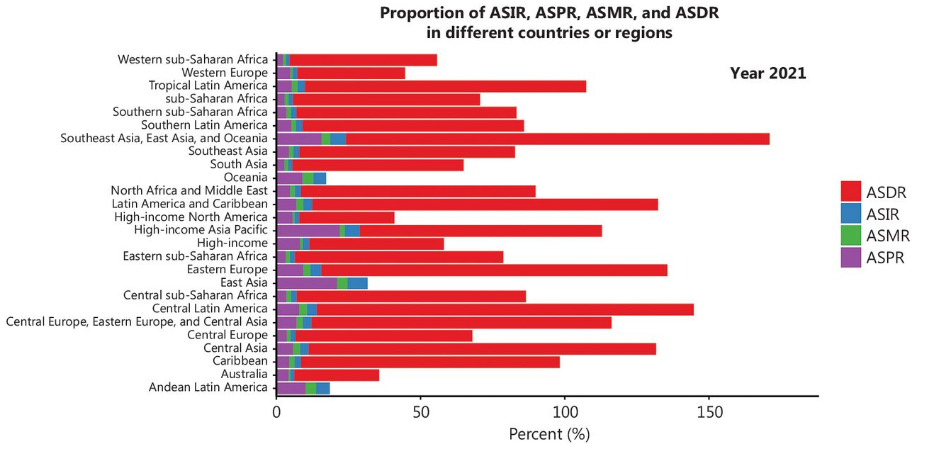
Proportion of EOGC ASIR, ASPR, ASMR, and ASDR in different regions globally in 2021.
FAYETTEVILLE, GA, UNITED STATES, February 19, 2026 /EINPresswire.com/ -- The global burden of early-onset gastric cancer (EOGC) has decreased over the past three decades, yet regional, gender, and socioeconomic disparities remain pronounced. This large-scale analysis, covering data from 1990 to 2021 and projecting trends to 2040, identified smoking and high-salt dietary intake as the leading modifiable risk factors. While public health interventions have effectively lowered incidence and mortality, the disease continues to disproportionately affect young adults in low- and middle-income regions. The findings emphasize the need for region-specific prevention strategies integrating smoking cessation, salt reduction, and improved access to early screening and treatment.
Gastric cancer remains the fifth leading cause of cancer-related deaths worldwide. Although its overall incidence has declined, early-onset cases—diagnosed before age 50—display unique biological and clinical patterns. These include diffuse histologic features, signet ring cell predominance, and poor prognosis. Environmental and lifestyle exposures, such as Helicobacter pylori infection, smoking, and high-salt diets, are known contributors. However, previous global studies have rarely focused exclusively on early-onset gastric cancer(EOGC). Due to these challenges, it is necessary to conduct in-depth research on the global distribution, risk factors, and future trends of EOGC to inform effective prevention
A research team from Chongqing Medical University, China, published (DOI: 10.20892/j.issn.2095-3941.2025.0320)their findings in Cancer Biology & Medicine, presenting the first comprehensive global analysis of EOGC from 1990 to 2021 using Global Burden of Disease (GBD) 2021 data. The study revealed that, despite a 2.9% annual decline in global mortality, inequalities between high- and low-income regions are widening. Smoking and high-salt diets were identified as the main risk factors, accounting for 7.1% and 7.7% of disability-adjusted life years (DALYs), respectively.
The study analyzed 371 diseases across 204 countries to assess the global burden of EOGC using Bayesian age–period–cohort modeling and joinpoint regression. In 2021, approximately 125,000 new EOGC cases, 78,000 deaths, and 3.86 million DALYs were recorded worldwide. The incidence peaked in individuals aged 45–49 years, with males showing higher prevalence, while females under 30 exhibited greater mortality risk. The age-standardized incidence and mortality rates both declined globally between 1990 and 2021, especially in East Asia and Europe. However, several sub-Saharan African countries experienced rising rates.
Smoking accounted for more than 10% of DALYs in East Asia and Central Europe, while high-salt diets showed consistent impact worldwide. Disparities were strongly linked to socioeconomic development: high-income regions achieved steady reductions through screening and health education, while low-income regions faced growing burdens due to limited healthcare access and population growth. Projections suggest a continued global decline through 2040, yet with persistent
“EOGC poses a complex challenge because it affects individuals during their most productive years,” said corresponding author Wei Wang from Chongqing Medical University. “Our findings show that preventive measures such as smoking control, salt reduction, and H. pylori eradication can significantly lower the disease burden. However, these strategies must be tailored to local conditions. In low-resource settings, strengthening healthcare infrastructure and expanding screening access are critical steps toward reducing disparities.”
The study underscores the importance of integrating lifestyle modification, early detection, and public health policy to address EOGC globally. High-risk regions such as East Asia should promote dietary interventions and early endoscopic screening, while low-income areas require investment in healthcare systems and public awareness programs. Tobacco taxation, food labeling, and salt reduction campaigns could further reduce exposure to key risk factors. Future research combining epidemiological data with genomic and environmental monitoring will help identify susceptible populations and optimize precision prevention strategies against EOGC.
References
DOI
10.20892/j.issn.2095-3941.2025.0320
Original Source URL
https://doi.org/10.20892/j.issn.2095-3941.2025.0320
Funding Information
This study was funded Chongqing Science and Health Joint Research Project in TCM (Grant No. 2024ZYDB002).
Lucy Wang
BioDesign Research
email us here
Legal Disclaimer:
EIN Presswire provides this news content "as is" without warranty of any kind. We do not accept any responsibility or liability for the accuracy, content, images, videos, licenses, completeness, legality, or reliability of the information contained in this article. If you have any complaints or copyright issues related to this article, kindly contact the author above.
